

Why Is CFMOTO So Cheap? Cost, Quality, and Ownership Factors
CFMOTO is generally cheaper because it combines large-scale manufacturing with value-focused pricing, includes useful equipment without charging as much for brand prestige, and is still building market share against longer-established powersports manufacturers.
The lower price does not automatically mean that CFMOTO uses poor-quality engines or unsafe designs. Current models compete with mainstream ATVs, side-by-sides, and motorcycles while often entering the market at a lower starting MSRP.
The tradeoff is that buyers need to examine more than the purchase price. Local dealer support, replacement-parts availability, warranty terms, resale value, and long-term model history may differ from what buyers experience with older, more established brands.
In practical terms, CFMOTO can be a strong value for riders who have a capable dealer nearby and are willing to maintain the machine properly. Buyers who prioritize the largest service network, the longest ownership history, or the strongest local resale demand may still prefer a more established brand.
Why CFMOTO Models Cost Less
| Pricing factor | How it lowers cost | What buyers should check |
|---|---|---|
| Large-scale manufacturing | Spreads development and production costs across more vehicles | Build quality on the exact model |
| Value-focused positioning | Uses competitive pricing to attract buyers | Final dealer price, not MSRP alone |
| Lower brand premium | Buyers pay less for an established name | Local resale demand |
| Included equipment | Reduces the need for immediate upgrades | Which features are actually standard |
| Growing market presence | Competitive pricing supports expansion | Dealer and parts support nearby |
These factors work together. No single explanation applies to every CFMOTO vehicle, and a lower MSRP does not guarantee that the final ownership cost will always be lower.
Is CFMOTO Cheap Because It Is Made in China?
Manufacturing location is part of the answer, but it is not the whole answer.
CFMOTO was founded in China and handles the research, production, and distribution of motorcycles, ATVs, side-by-sides, electric vehicles, and major components. The company now operates manufacturing and research facilities while selling products across more than 100 countries and regions. This scale can help spread tooling, engineering, and production costs across a large number of vehicles.
However, saying that CFMOTO is cheaper simply because it is Chinese is an oversimplification. Powersports manufacturing involves design, testing, electronics, engine development, emissions compliance, distribution, dealer training, warranty service, and replacement parts—not only assembly labor.
CFMOTO also continues to invest in product development and technical partnerships. For example, the company announced an expanded strategic partnership with Brembo in 2026 for future motorcycle braking development. That does not prove that every model matches every competing brand, but it shows that CFMOTO is not operating only as a low-cost assembler.
CFMOTO Uses Value-Based Pricing
Established brands can charge more partly because buyers already recognize their names, understand their resale markets, and have years of ownership data available.
CFMOTO is still strengthening its position in the U.S. market. Competitive pricing gives buyers a reason to consider the brand instead of automatically choosing Polaris, Can-Am, Honda, Yamaha, Kawasaki, or another familiar manufacturer.
This is a normal market-entry strategy: provide a useful combination of performance, equipment, and price so that buyers are willing to try a less established option.
That does not mean every CFMOTO is the cheapest vehicle in its category. Premium machines such as the turbocharged ZFORCE Z10 and climate-controlled UFORCE Highland models have moved the brand into higher price ranges. CFMOTO remains value-oriented, but its lineup now includes both entry-level and premium products.
Current CFMOTO Price Examples
The following starting prices were reviewed from current U.S. 2026 model pages. They exclude freight, setup, taxes, registration, dealer accessories, and other possible charges.
| 2026 model | Category | Starting U.S. MSRP | Best suited for |
|---|---|---|---|
| CFORCE 800 Touring | Two-seat ATV | $9,499 | Trail riding and utility use |
| UFORCE 600 | Utility side-by-side | $10,999 | Light property work |
| UFORCE 1000 | Utility side-by-side | $13,999 | Hauling, towing, and farm work |
| ZFORCE 800 Trail | Sport side-by-side | $13,999 | Narrow recreational trails |
| ZFORCE Z10 | Turbo sport side-by-side | $19,999 | High-performance riding |
Current official pages list the UFORCE 600 at $10,999, UFORCE 1000 at $13,999, ZFORCE 800 Trail at $13,999, and ZFORCE Z10 at $19,999. Actual dealer pricing and availability can differ.
These figures show why “cheap” is not always the best description. A better description is competitively priced for the engine, capacity, and included equipment.
Does CFMOTO Include More Standard Equipment?
One reason CFMOTO attracts value-focused buyers is that many models include equipment that may be optional or package-dependent elsewhere.
Depending on the exact vehicle, this can include electronic power steering, a winch, LED lighting, mirrors, roof panels, digital displays, drive modes, or protective components. Equipment varies significantly by model and year, so buyers should compare the standard-equipment lists line by line rather than relying on general brand claims.
Included features can reduce the amount that an owner needs to spend immediately after purchase. However, they only create value when they are features the buyer will actually use.
A farm owner may place more value on a winch, cargo-bed capacity, and towing rating. A trail rider may care more about suspension travel, vehicle width, seats, and underbody protection. A commuter buying a motorcycle may prioritize ABS, display technology, and fuel range.
Compare complete configurations, not only engine displacement or starting MSRP.
Does a Lower Price Mean Lower Quality?
Not necessarily. Price and quality are related, but they are not the same measurement.
Modern CFMOTO vehicles use fuel-injected engines, CVT systems on many off-road models, electronic power steering, selectable drive systems, and model-specific safety or rider-assistance features. The company also offers everything from small-displacement entry models to 154-hp turbocharged side-by-sides.
Still, buyers should expect possible differences in areas that are difficult to judge during a short showroom visit:
- Long-term durability over many years
- Fit and finish around body panels and cab components
- Noise, vibration, and heat management
- Dealer diagnostic experience
- Replacement-parts lead times
- Used-market demand
- Availability of model-specific accessories
Quality can also vary between models and generations. A positive experience with one CFMOTO ATV does not prove that every side-by-side or motorcycle will perform identically.
Research the exact model rather than buying only on the reputation—or criticism—of the brand as a whole.
Is CFMOTO Reliable?
CFMOTO can be reliable when the vehicle is correctly maintained and used within its limits. However, reliability depends on the model, riding conditions, service history, and quality of dealer preparation.
Newer designs may include improvements over earlier generations, but some models do not yet have the same decades of North American ownership data as long-established competitors. That makes preventive maintenance and local dealer support especially important.
Before purchasing, ask the dealer:
- Which repairs are completed in-house?
- Which common service parts are normally stocked?
- How long do model-specific parts usually take to arrive?
- How are warranty claims submitted?
- What is the first-service interval and typical cost?
- Are diagnostic tools and trained technicians available for this model?
A responsive dealer can make ownership significantly easier. CFMOTO USA provides a dealer locator, but buyers should still contact nearby locations and evaluate their service departments before purchasing.
Warranty and Parts Availability
Many current CFMOTO off-road model pages advertise a one-year factory warranty. The official warranty information also applies shorter coverage periods to certain batteries, filters, belts, wheels, cables, and other service or wear-related components. Coverage can vary by product category, component, use, and model year.
Read the complete warranty rather than assuming that every part is covered for the full vehicle-warranty period. Ask what maintenance records are required and whether aftermarket modifications could affect a claim related to the modified system.
Routine maintenance parts may be readily available, but body panels, electrical modules, trim pieces, and model-specific assemblies can depend more heavily on dealer inventory and distribution.
Check availability before buying if the vehicle will be used commercially or cannot remain out of service for an extended period.
The Real Cost of CFMOTO Ownership
The purchase price is only one part of total ownership cost.
| Cost area | Potential advantage | Possible tradeoff |
|---|---|---|
| Purchase price | Lower entry cost on many models | Freight and setup can reduce the gap |
| Standard equipment | Fewer immediate upgrades required | Some factory equipment may not suit every rider |
| Maintenance | Common service tasks may be straightforward | Dealer labor and parts access vary |
| Accessories | Aftermarket support is expanding | Exact year and trim must be checked |
| Resale | Lower initial investment | Local resale demand may be less predictable |
Get an out-the-door quote that includes freight, setup, documentation fees, taxes, registration, financing, and installed equipment. A low advertised MSRP can become less attractive after dealer charges are added.
Insurance, scheduled maintenance, tires, drive belts, batteries, transportation, and accessories should also be considered.
CFMOTO UForce and ZForce Series
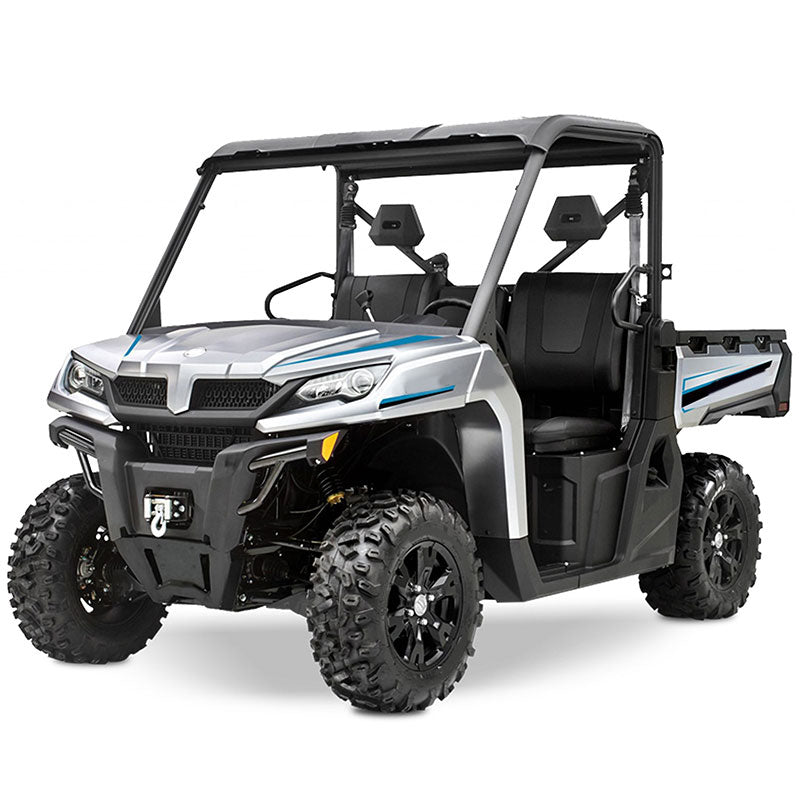
CFMOTO’s off-road lineup includes two main side-by-side families. The UForce series focuses on utility tasks such as hauling, towing, property maintenance, hunting, and carrying passengers or equipment. The ZForce series is designed more for recreational trail riding, with a greater emphasis on suspension, handling, and performance.
At StarknightMT, years of working with CFMOTO owners have shown us that choosing the right series matters more than selecting the largest engine. Buyers who need cargo capacity and practical work features will usually be better served by a UForce while riders who prioritize trail performance and a sportier driving experience may prefer a ZForce.
Final Verdict: Is CFMOTO Worth the Lower Price?
CFMOTO is cheaper mainly because it competes through value, manufacturing scale, competitive market positioning, and a lower brand premium—not because every part is automatically lower quality.
For the right buyer, that can mean more equipment and capability for the budget. The main tradeoffs are less predictable local support, parts timing, resale demand, and long-term ownership data compared with some established brands.
Compare the complete out-the-door price, test the exact vehicle, research the local dealer, read the warranty, and confirm parts availability. When those points check out, CFMOTO can be a sensible purchase rather than simply a cheap one.
Frequently Asked Questions
Q1: Is CFMOTO Reliable?
A1: CFMOTO can be reliable when the vehicle is maintained correctly and used within its rated limits. Reliability varies by model, model year, riding conditions, service history, and dealer preparation.
Before buying, research the exact model and confirm that a qualified local dealer can provide routine service, diagnostics, warranty support, and replacement parts.
Q2: Why Are CFMOTO Models Cheaper?
A2: CFMOTO combines large-scale manufacturing with competitive pricing and generally charges less of a premium for brand history. Many models are also positioned to deliver useful standard equipment at a lower starting price.
The lower MSRP helps CFMOTO compete with established brands, but buyers should compare freight, setup fees, dealer support, warranty coverage, maintenance, and resale—not only the advertised price.
Q3: What Should Buyers Check Before Purchasing a CFMOTO?
A3: Check the out-the-door price, local dealer reputation, warranty details, service intervals, parts availability, insurance cost, and local resale market.
Buyers should also test ride the exact model and verify its towing, cargo, seating, width, weight, and accessory compatibility. For aftermarket products, always match the exact year, model, trim, and mounting location before ordering.
Read More
CFMOTO U10 Pro Highland Review
12 must-have CFMOTO accessories
2026 CFMOTO Side-by-Side Buyer’s Guide


Leave a comment