

RZR Pro XP vs RZR XP 1000

Quick Overview: What’s the Difference?
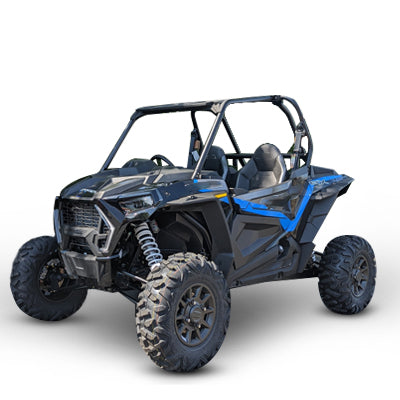
Though similar in name and appearance, the Polaris RZR Pro XP vs RZR XP 1000 have substantive differences. In particular, the suspension, interior and even the tires are distinctly different.
There’s no need to take each out for a test ride on the trails. StarKnightMT has you covered. Here are the key factors to consider along with some accessories to get the most out of each UTV:
1. Interior comfort and ergonomics
If you are fairly tall, you’ll likely lean toward the Polaris RZR Pro XP as it has more leg room than the Polaris RZR XP 1000, providing a couple more inches to accommodate the knees. The Pro XP’s seat is also more comfortable and relaxed compared to the relatively upright seats of the XP 1000.
The Pro XP is also revered for its driver seat that slides closer toward the steering wheel than that of the XP 1000. This seemingly minor subtlety is important for short drivers. Moreover, the Pro XP’s sliding seat conveniently moves along rollers, while the XP 1000 is a simple slider.
2. User experience design and vantage point
Though the RZR XP 1000 also has a new dashboard and provides a superior over-the-hood view, it’s not enough to tip the scales in its favor. Overlook the fact that the RZR Pro XP’s vantage point diminishes sight a foot sooner than the XP 1000, and you’ll find this version is slightly superior.
3. Control when taking to the trails
The RZR Pro XP drifts and slides better than the RZR XP 1000 thanks to its Maxxis Carnivore tires. The XP 1000 is equipped with ITP Coyotes that most characterize as sufficient for straight line grips, yet lacking the profile of the Carnivores.
Add in the fact that the Pro XP’s clutch is surprisingly cool when running, thanks to heightened airflow that also serves to extend belt life, and there is even more reason to favor this model.
|
Summary of comparison points |
||
|
Feature/Category |
Polaris RZR Pro XP |
Polaris RZR XP 1000 |
|
Engine |
114-hp ProStar 1000 Gen-2 Engine |
110-hp Parallel Twin 4-Stroke 999cc Engine |
|
Top Speed |
86 MPH |
92 MPH |
|
Ground Clearance |
14.5-inches |
16-inches |
|
Screen Size |
7-inch Display |
7-inch Display |
|
Navigation System |
Ride Command Off-road Mapping System |
Ride Command Off-road Mapping System |
|
Audio |
Rockford Fosgate® Stage 3 |
Rockford Fosgate® Stage 3 |
|
Suspension |
20-inches |
18-inches |
|
Shocks |
Walker Evans Racing Needle |
Walker Evans Needle with 16 clicks of adjustment |
|
Wheelbase |
96-inches |
90-inches |
|
Stance |
64-inches |
72-inches |
|
Weight |
1,795 pounds |
1,779 pounds |
|
Feature of Note |
6 plug-and-play ports |
4 coaxial speakers and a 400-watt amplifier |

Engine & Power
Let’s cut to the chase: power and speed. Next to handling, there’s nothing more important in a UTV than power. However, there is no clear winner in the power category.
Each UTV has a distinct motor, yet the differences between the two are insignificant. Polaris engineers highlight how the powerplant within the RZR Pro XP has superior reliability, combined with turbo cooling and an enhanced clutch. Such features are certainly important for those intent on winning races, yet they aren’t essential for adventurous trail rides.
If racing is your thing, you’ll find the Polaris RZR Pro XP and Polaris RZR XP 1000 have negligible performance differences. Pit them head-to-head in drag races, and you’ll find they nearly tie every single time.
The Pro XP is designed with an electronic limiter ensuring it doesn’t surpass the 86 MPH mark. In contrast, the XP 1000 can reach 92 MPH.
Though there are no significant quantifiable power differences between the UTVs, most admit the RZR Pro XP has a more powerful feel when behind the wheel. In particular, drivers rave about the RZR Pro XP’s lengthier and lower chassis.
Press the pedal to the metal and you’ll find the Pro XP is more stable and smoother than the XP 1000 when cornering. When the brakes are hit at 70 miles per hour, the Pro XP slows 10 feet shorter than the XP 1000.
Suspension, Travel & Handling
The Polaris RZR XP 1000 has an impressive 16-inch ground clearance, ensuring the underbody of the vehicle remains safe when traversing unknown parts. You can take on most obstacles without worrying about whether the undercarriage will be dinged and damaged.
On the Polaris RZR Pro XP, you’ll find 14.5-inch ground clearance. The Pro XP has more robust A-arms with just the right width. The Pro XP’s stance measures 64 inches, while the XP 1000 has a 72-inch stance.
Polaris engineers also went to the extent of installing a brand new C-channel style trailing arm on the rear of the Pro XP. Though this trailing arm isn’t the strongest, riders haven’t noticed any significant issues.
In general, the prevailing sentiment favors the tube style trailing arms of the RZR XP 1000 as there is significantly less worry when taking on sharp corners at high speeds.
Controlling the RZR XP 1000 exactly as desired is that much easier thanks to its widely lauded ITP Coyote tires.
The XP 1000 has 32-inch ITP Coyotes. Though these tires are a couple of inches smaller than the Pro XP, some drivers prefer them.
Neither UTV’s turn radius is significantly better than the other’s. The XP 1000 is the wider of the two and struggles to execute a full turn within a 40-foot space. In contrast, the Pro XP requires half a dozen fewer feet to complete a U-turn when traveling at a low rate of speed.

Comfort, Cabin & Technology
Sit in the cockpit of the two UTVs, and you’ll likely agree that the Polaris RZR Pro XP’s interior is better.
The Pro XP has superior cockpit features highlighted by the following:
· Several storage boxes
· A lengthier seat adjustment throw
· Passenger grab handle
· Responsive steering wheel
· 6-point seat belts as opposed to the conventional four-point design
Though the Polaris RZR XP 1000 cockpit is a step up from the previous design, most agree it is substandard when juxtaposed with the Pro XP. The XP 1000 has myriad pockets and storage spaces for driver sundries. All in all, these storage spaces outmeasure those of the Pro XP on a per square inch basis.
Spend a couple of hours in each UTV’s seat, and you’ll find the RZR XP 1000 has a comfier foam cushion. Moreover, the XP 1000’s seating position is also more ergonomical than that of the Pro XP. However, the XP 1000 interior can be criticized for insufficient elbow room, partially because the door is equipped with a speaker.
In terms of user experience design, the RZR Pro XP is the victor. Take a look around the Pro XP interior, and you’ll find all sorts of convenient places to store your personal items.
The Pro XP steering wheel telescopes and tilts to perfection. Factor in the superior steering wheel grip, combined with the adjustable grab handle for the passenger, and there is even more reason to choose the Pro XP.
We would be remiss not to mention that the XP 1000 has full doors while the Pro XP has a door opening. However, the Pro XP makes up for this shortfall with its adjustable shocks and Ride Command feature that can be electronically controlled directly from the steering wheel. The feature is highlighted by off-road GPS and the ability to see other drivers’ locations and their rate of speed.
Reliability & Maintenance Differences
Though the UTVs have distinct motors, they perform similarly. The engine isn’t a deal-breaker with either vehicle.
Polaris engineers are adamant that the Polaris RZR Pro XP powerplant provides exemplary reliability, along with a superior clutch and cooling system. The Polaris RZR XP 1000 is user-friendly in that its engine and other components are easy to access, inspect and service. However, mechanics have mentioned that the Pro XP engine is easier to maintain and repair as its cargo tray can be removed with ease for better vision and access.
Hit the trails with either of these UTVs, and you probably won’t have an issue with belt wear, overheating or other mechanical issues. Both are reliable UTVs with minimal maintenance needs.
Best Fit for Each Rider Type
Those looking to take on undulating terrain at high speeds will favor the RZR XP 1000 for its higher ground clearance and faster top speed.
Those who prioritize control, joyriding, and the excitement of off-road drifting will favor the RZR Pro XP. In short, the Pro XP prioritizes fun while the XP 1000 prioritizes adrenaline-fueled, worry-free adventuring.
Conclusion
In the end, it’s difficult to choose between the Polaris RZR Pro XP and Polaris RZR XP 1000. If UTV suspension and handling are at the top of your checklist, you’ll lean toward the XP 1000.
If cabin comfort and style are your priorities, the Pro XP is your best bet. The Pro XP clearly has a superior cockpit and interior features. In the end, the Pro XP is the winner, albeit by a slim margin.
FAQs
Q1: How large is the RZR Pro XP gas tank?
A1: The RZR Pro XP has a 12-gallon gas tank.
Q2: Which of the two UTVs has more leg room?
A2: The RZR Pro XP has more leg room, especially at the all-important knee area that tends to be cramped in UTVs and most other vehicles.
Q3: Which is the better of the two UTVs?
A3: Though the Polaris RZR Pro XP and RZR XP 1000 are fairly similar vehicles, they have meaningful differences every prospective buyer should be aware of. Choose the RZR Pro XP, and you won’t be disappointed.


Leave a comment